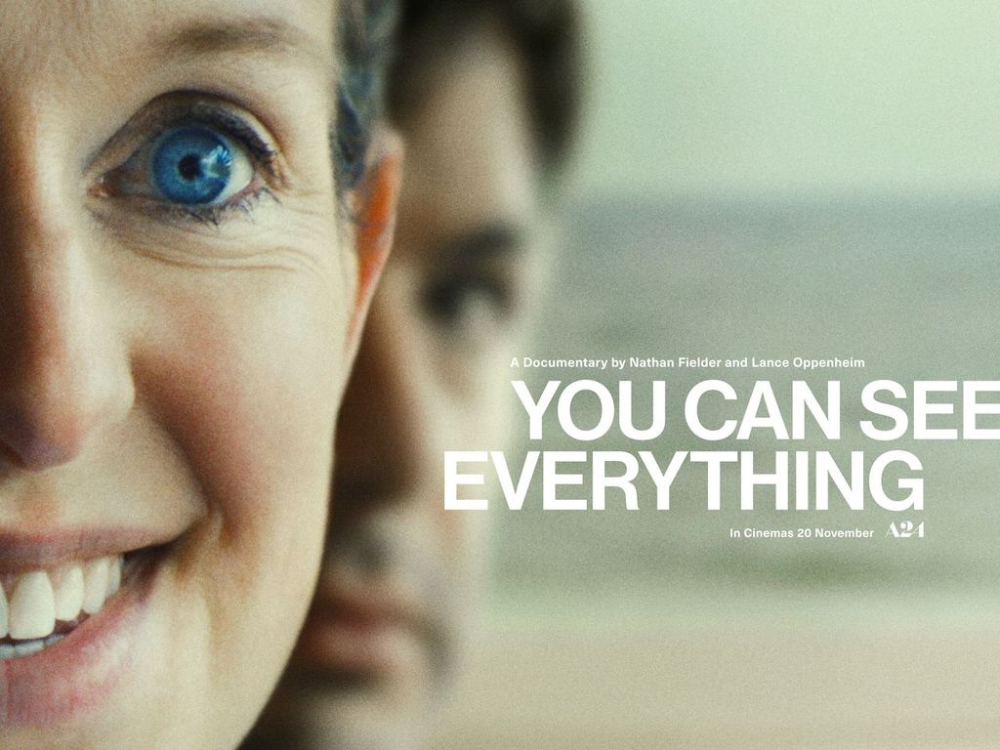
What’s The Film? The 2026 documentary You Can See Everything
What’sIt All About, JG? It’s about Nathan Fielder (and director Lance Oppenheim) trying to get to the bottom of an enigma, specifically Elizabeth Holmes, the disgraces CEO of Theranos what was jailed for eleven years after being convicted of defrauding investors.
In the first part of the film, Fielder moves in with Holmes and her family, boyfriend Billy Evans, and their young child, in the days before she begins her incarceration. Then, in the second part, once she’s under lock and key, he spends time investigating Evans, touches on tech-bro culture, family, and other elements that make up the Holmes story, culminating in a frankly staggering conclusion where Amanda Seyfried (who played Holmes in the TV adaptation of her life, The Dropout) re-enacts with Fielder a visit he had to her prison to discuss Evans demanding money from the film that Holmes was apparently unaware of.
It’s a lot.
Why Did You Give It A Go? I can’t remember the last time a documentary was this buzzy, but honestly it might be as long ago as something like Michael Moore’s Fahrenheit 9/11. You Can See Everything has been rapturously received in a way that’s not exactly what you’d call common for a documentary, but more than that, the praise has been near-universal. That makes it an interesting proposition. And I’m a huge fan of The Rehearsal (thanks to my fella showing it to me – thanks, fella!), which introduced me to Fielder’s patented deadpan, genuine sincerity, and mix of humour and seriousness. All in all, it was pretty unavoidable.
Is It Any Good? Fuck yes. It is, in fact, an extraordinary piece of work and deserves pretty much all of the praise lavished on it. For one, Holmes herself is a near-perfect subject for someone like Fielder to get to work on. There are, of course, the big headlines surrounding the scandal – the device that didn’t work, the fraud, the astonishing emotional trauma caused to the patients through misdiagnosis, the huge sums of money and, ultimately, the prison sentence. But Holmes herself isn’t necessarily someone who fits the mould of the sort of person that would do that. She’s quiet, softly spoken (fey, even), and approachable. It’s disarming, but then again that’s kind of the point – she’s accused of manipulating people, and that’s exactly the kind of act that would, indeed, work – especially on older, not-very-tech-savvy money-men who, it is easy to imagine, would be taken in by such a performance.
But that’s one of the fundamental questions being asked here – is it a performance? Fielder doesn’t necessarily dig into this so much as gently weed around the subject, but this is a fertile approach. Holmes sort of wafts through the movie, sometimes coming across as almost dissociative, sometimes “energised” (after a call with would-be investors in a follow-up to Theranos), sometimes very acutely aware of the time she’s about to spend behind bars. As the principal subject, she’s slippery and hard to read, and it’s genuinely difficult to tell how much of what comes across is genuine, how much of it is put on, and how good of an actor she is to try and engage our sympathies (hint: there are a lot of tears).
One of the big questions – one that seems destined to remain unanswerable – is, why did Holmes and Evans allow Fielder into their lives at such a crucial moment, in the run-up to her jail sentence? Near the start of the film, Evans suggests that it’s because he thinks Fielder is the sort of person who will ask questions and find the truth (which is, of course, the truth that Holmes and Evans want to project, rather than “objective’ truth), but that’s too pat an answer. It’s clear neither Holmes nor Evans know anything about Fielder, his previous work, or what he’s like as a person. The practical aspects are known now, including how Fielder got involved, but why follow through without actually investigating? Baffling. His slow, quiet, cumulative form of interrogation seems custom-built to break down people like Holmes and Evans, so why would they subject themselves to that? Are they so deluded they can’t see what’s going on? It’s possible – early in the movie, we witness Holmes and Evans being transparently manipulative before she sends him a text message saying, “you can see everything!” which he responds to with a doleful thumbs-up. Yeah. We sure can.
It’s an extremely funny moment, and that’s the other thing about You Can See Everything – it’s a very funny film. Maybe that shouldn’t be a surprise, given that it’s been made by, you know, a comedian, but investigating a huge fraud perpetrated by someone who seems almost psychopathically unaware of their own failings doesn’t necessarily scream laugh-out-loud fun. But this is a genuinely funny movie, which helps both to leaven the seriousness of what’s being discussed and, occasionally, dissipate the almost overwhelming awkwardness (intentional awkwardness, to be clear) and pressure of the situation.
And if that were all the film was, it would be great. But it isn’t, of course. Because once Holmes is sent to jail, the focus of the film shifts, and in a spectacular way that is really what separates this out from anything that’s really come before it. Initially, we spend more time with Billy Evans, who seems absolutely determined to prove what a complete piece of shit he is at every occasion. We also get to spend time with an investor who thinks, somehow, that “Theranos 2” will work because you learn from your mistakes (the speed at which Evans shuts this interview down is both extremely funny and extremely telling).
And then, in the film’s most audacious move, Amanda Seyfried comes on board, thanks to her experience playing Holmes in The Dropout. Initially, she’s there to provide context, then she gets drawn into meeting Evans (“I feel like an undercover cop”, she tells us) to try and dig out some dirt – she hates him every bit as much as the audience probably does at this point. Eventually, she ends up playing Holmes again as Fielder puts his The Rehearsal experience to good use, recreating a visit he made to Holmes while she was incarcerated to try and establish whether she was aware Evans had asked to profit from the film and also if she’s aware of what he’s doing with things like her social media accounts.
If there’s a hero to this film, it’s Seyfried, who’s just brilliant beyond words, caught up in a situation she couldn’t possibly have conceived of when she originally took the role of Holmes in The Dropout. She’s utterly unafraid of Evan’s pathetic attempts to bully her when she and Fielder visit him one evening, and after a particularly loathsome exchange from him where he defends Charlie Kirk, she’s quite happy to say to his face, “Well, he was a pussy”. Yet it’s the additional perspective he supplies that’s really the most important thing here. She’s saying what much of the audience is thinking, sure, but it also gives us a break from Fielder slow-and-steady-wins-the-race approach and from the flat confrontationist stance of Evans and the delusions of Holmes. And, yeah, that final scene when she plays Holmes once more…
It’s breathtaking – a fitting climax to a film, certainly, but as well as showing off just what a good actor she is, it gives us further insight into Holmes when Holmes can’t articulate anything herself. Has prison changed her? It doesn’t seem like it, but we’re dependent on Fielder’s recreation to draw that conclusion, as well as Seifried’s interpretation of what he’s written. It becomes easy to forget that we’re watching a performance. Then, at the end, we see Fielder and Seyfried working on the script lit only by a roaring fire, reinforcing the artificiality of what we’ve just watched and inviting viewers to interpret not just the scene but their performance of it.
Throughout the film, the audience is frequently asked to interpret what’s going on, but it’s in these final moments that how much that means and matters is really driven home. It’s a remarkable end to a remarkable film.
How Many Of These Have You Seen? In terms of Fielder’s previous works, just The Rehearsal. I tried with Nathan For You, but ultimately it’s just Not For Me. Good, well written, and well performed, but it’s a level of cringe comedy that’s just too much for me, and I’m not much of a cringe comedy fan at the best of times. The Rehearsal, however, is quite, quite remarkable.
Would You Recommend It? Well, naturally, yes. It’s not often a film like this comes along – one that simply redefines how well this type of film can be put together. All of the bits of the film exist in previous forms – the recreation is obviously a direct continuation of The Rehearsal, the in-your-face camera work comes from any number of fly-on-the-wall documentaries, and so forth – but rarely have they ever been assembled in such a compelling manner.
Once thing it’s important to note, though, is that You Can See Everything isn’t objective, nor is it trying to be. The ominous, often atonal score frequently tips the filmmakers’ hand as to whether they really believe in the sincerity of what we’re seeing on screen. This is especially true in the first half of the film, when Holmes is an active participant, and while it’s clear that Fielder’s perspective does develop over the course of the film, those scenes prior to the incarceration really do imply a point of view.
But, it’s also important to note, that’s fine. The film doesn’t disguise its agenda at all, and simply because it suggests something doesn’t mean the audience has to follow that line of reasoning. And it’s certainly not always the case. What’s become one of the most contested scenes of the film, where Fielder shows Holmes the famous “Who’s On First” sketch, allows the viewer to entirely decide whether Holmes genuinely doesn’t get the joke or whether she’s faking it as a way of covering up her use of language – a use that’s frequently interrogated in the film and vital to understanding whether Holmes is real or fake. Evans tries to chime in with a sleazy-politician deflection, “I’m glad you showed that to us”, but it looks for all the world like he’s covering for Holmes because she’s been found out rather than allowing her to answer. In the end, she says she doesn’t get the joke, but is that true? And that really is the question.
Then there’s the jaw-dropping scene where Fielder asks her father when things maybe started to go wrong for her, and he almost casually replies, “Oh, when she was raped”. Apart from being phenomenally insulting to other rape victims – not all of whom, you will be shocked to learn, go on to be found guilty of billion-dollar fraud – the sheer off-handedness of the delivery, as if it’s the most obvious thing in the world, doesn’t need underscoring. The audience can reach their own conclusion, but it’s not exactly hard to work out what that’s going to be.
And that’s why this is such an easy film to recommend. Just when you think you’ve seen it all, another moment comes along that takes your breath away, and not always – or even usually – in a good way. But those moments keep coming, and the build to the climax is never less than urgent, even when the pace is slow. I feel like I’ve barely scratched the surface here and there’s a dozen more scenes I could easily ramble on about. I mean, I haven’t even mentioned the deeply weird scenes of Holmes and Evans creating an AI version of Holmes for… reasons.
Now, not every moment completely lands, to be fair. Huge emphasis is given, early on, to a piece in the New York Times, questioning Holmes’s use of language in an interview. How Holmes uses language is seen as the key to unlocking her. Evans frequently implies she might be autistic or on the spectrum but never actually comes out and says it directly. This is pretty sleazy, as per his usual modus operandi, since the unspoken implication is that if you do criticise her because she’s autistic, then you’re the bad guy because you’re attacking someone who’s vulnerable. But he never says it says it because presumably she’s never actually been diagnosed with anything. But again, it all comes back to language.
If she genuinely doesn’t quite understand that other people misinterpret her words, she could conceivably be a victim (that’s why the Who’s On First sketch is so important). If she understands it then, yes, she’s a fraudster. Yet the issue of the interview is never resolved, dropped from the rest of the film, and is almost dismissively referred to in a quick bit of closing text. It’s a clumsy bit of mishandling that needed to be either trimmed back or properly settled – since both parties claim to be right and there are meant to be recordings, how come neither side ever produces one? That’s an important question that remains frustratingly unanswered.
But those kind of missteps are few and far between, and overall, it’s remarkable just how coherent a film of this length is. Because at just fractionally under three hours, this is a long film by most standards but it never fails to be compelling, never fails to be interesting, and, in its whirlwind climax of reconstruction, memory, character, and acting, achieves something genuinely remarkable.
The only downside to all of this is imagining how Fielder can possibly top it.
Scores On The Doors? 9.5 / 10

